Wednesday, 29 April 2015

William Eggleston

William Eggleston born in Tennessee in 1939 is a photographer widely known for his colour photography as an accredited artist medium. He got his first camera at the age of 18, whilst practising with black and white film and printing his own work. Initially he had little knowledge of photography but from this he taught himself through practise. He then went on to study Art at various colleges but never graduated.


William was particularly influenced by the artist Henri Cartier-Bresson for the simplistic imagery but descriptive through composition. This inspired William to shoot thousands in and around his own town of which he has lived in throughout his entire life, he called his subject banal (plain). The pictures below show his inspiration for photography the 'ordinary' and 'plain', you see similar styles to their work, for example here they both show a relaxed atmosphere, almost worn out but then a difference through it's camera techniques and technology through the use of colour and age of the photographs. However both photos allow you as a viewer to imagine what the person within the photograph is feeling or thinking allowing you to come up with your own interpretation of the meaning and opinion of the photo.


Henri Cartier-Bresson
William Eggleston

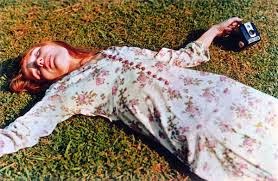
Through the documentary that I had watched about William Eggleston i found out that he finds it hard to answer the question of 'What he photographs?' as there is no other answer than "life today". He believes in taking one picture at one time, this is because it stops you from getting confused over which picture is the most successful. He also leaves his images untitled as he feels like titles take the meaning away from photography. Also, he wants the viewer of the photo to discover their own interpretation of it without being influenced by the title.


Untitled by William Eggleston


William believes in not taking anything for granted in the sense of photographs, every tiny space counts. He treats everything that he witnesses equally symbolizing that all of his pictures of 'nothing' are worth something by declaring it a picture. His most notable work to date would have to be 'The Red Ceiling'. The work he produces is routed from his origins. He explained that he took this image out of the blue whilst talking with friends in bed, he randomly snapped up the image and they carried on talking. The function of all his photos are too evidence life as it is at that time. This is reflected through today's society as a lot of the population takes some form of image everyday using their smart phone or camera, it shows us how imagery has taken over our lives and how evidencing our lives is still used today without us even realising. Of which this image portrays this idea well due to the random composition of such a normal object that we use daily.


The quality of his work shows as he focuses on getting the image correct the first time as i have explained previously, it makes you concentrate on what you want to get out of an image and not what you could possibly achieve, bringing out motivation and thriving you to challenge imagery and art.


He progressed with his skills and love for art by being the first to bring colour into the art world through dye printing, which was used frequently within advertising, commercial and fashion photography. At this point in his life people were shocked and thought his images of colour were awful and did not appreciate them as the colour had showed what viewers already knew of. The function of the photographs were to document 'life' almost like a snapshot of time, representing a memory for somebody. The images work well as William Eggleston has used space within the photographs to balance out the bold colours. The composition of the photos work particularly well within these two images due to the central composition in the first image, the portrait automatically grabs your focus and the leading lines guide you across the image. Within the second image of the red car, the composition is at a diagonal to the puddle of water almost making a frame of which your direction of focus is guided to. His work also stands out for the interesting angles within both of these pictures, one being high, the other low, his innovative style means he stands out against other artists.


William Eggleston - unseen Kodachrome dye transfer process photos.
These have been printed from the same group of 5,000 Kodachrome slides from which Eggleston’s first exhibition in 1976 at the Museum of Modern Art were taken and have been produced using dye transfer.


Whereas now colour is such a big part of photography and commercial advertising it comes naturally, you will see this though my own pictorial response as the colours within today's society are so vibrant and contrasting. It shows as time went on people have started to accept the impact of colour and how it is not only used in advertising but also day to day life. Therefore linking to the idea of my interpretation of 'life today'.

My Pictorial Response:


Personally I feel like my images do not reflect the style of William Eggleston, this could be because of the different era, time frame and geographical location used. As William lives in America and my images are within the UK, there is a clear difference between the physical appearance making my images associated more with architecture and cityscapes, whereas William has lived in Tennessee in a relaxed and rural location. Similarly fashions and styles have developed over the decades making the images appear different.


Bibliography

DVD: 'The Colourful Mr Eggleston' - https://www.youtube.com/watch?v=3jZ_HkaTXh8

http://www.telegraph.co.uk/culture/film/3647871/A-very-singular-vision.html

Tom Hackett


Today we had another guest lecturer talk to us about the work that he produces and Art and Design itself. He is called Tom Hackett and is a sculptor based in the UK who makes public and gallery based installations using multiple objects. He makes sculptures across a wide range of media and concepts.


He mainly spoke about his aim to find out why he produces the things he does, he explains that this is key for all artist designers, as well as communication and how you have to persuade an audience. He also explained how Art is an active process and how it is ever changing and evolving.


Since working as an artist and a sculptor, he has also learnt new skills to help him be inspired by the work of others and to put new skills from other fields into his sculptures. For example he learnt net making when creating a 3000 square foot fabric net sculpture at Mappin Art Gallery and Aberdeen Art Gallery. The scale of the work is phenomenal and automatically intrigues you to explore the photo or the physical object. This inspires me to learn many skills within Art and Design to then help me with my future work, it suggests that the more skills you learn the more successful you'll become.


He discussed the idea of being able to control people easily with an object and space, and how he likes that his art can do this due to the abstract ideas he produces. 


He believes that Art is a gift of the World. He likes ordinary, non precious things. Almost the idea of surrealism but not at the same time, as he doesn't like the corny and cheesy connotations that come with this. His work is different because of the displacement within it. He engages his audience through dislocation of objects and subjects, not the ordinary. It makes people stop and reappraise, giving them the idea of how do you fix the un-fixable.


Tom Hackett likes to question a lot of things but he believes that you have to believe in yourself and the work you produce but others need to believe in you as well in order for you to flourish and grow as an artist.


Bibliography

http://www.tomhackett.org/

Annie Leibovitz


Annie Leibovitz born October 2, 1949, in Waterbury is an American portrait photographer reasoned as one of America's best. 


She developed her own style and memorable trademark through the use of bold colours and compositions whilst working for Rolling Stone. 


Her work tends to feature a range of subjects from Pop culture to Politics. It was within her early years that she developed a style of photojournalism and started working for Rolling Stone in 1970. In 1983 she began working for the entertainment magazine Vanity Fair of which her work is most familiar to her audience. During the late 1980s, Leibovitz started to work on a number of high-status advertising campaigns. Also from the 1990s to the present, she has been publishing and exhibiting her work.


Leibovitz as an artist does a range of work both with commercial purpose and for fine art projects. She photographs everything, her life and everything within it. Her style of reporting portrays itself through the power of her images. She explains within an interview that a Photographers life is working through a lens. Annie has a strong character and is always enthusiastic in all that she does, she says she can never say no to something there is always something to drive her as a person to achieve bigger and better things.


Not only is she passionate with her work but as a mother, she always puts her family first and loves to be around them as she was brought up within a strong bonded community with both family and friends. By being such a dedicated mother and through the lifestyle she had as a child she has learnt to love and travel around the world to take photographs. She has always seen life through a frame as when she was a child her family were on the move constantly within the car, like as if the window was the frame.


Initially as a child she wanted to become an Art Teacher, but she soon realised you have to be an artist previously to become a teacher to inspire new generation. So she decided to go to plenty of workshops of which she developed her love for photography even more. Where she would take photographs and discuss within a group of people the positives of the photography similarly to most artists within today's society. She was particularly inspired by Henri Cartier Bresson and Robert Frank as at the time of her childhood they were the big shots who she lived up to.
She states that 'Magazines are empty canvases waiting to be filled with imagery, powerful imagery', this is particularly why she loved working with Rolling Stones as she was able to put her own style upon the work included. From her passion for travelling she collaborated with people who shaped her world through communication, not only this but as a hard working individual she put herself out there to gain opportunities.


From her own opinion she believes that the best photography is what is around you and that you have to become part of the photograph to make the best photographs. To achieve depth and meaning within her photos she adapts to the circumstances of the shoot. By doing this she settled in well due to her natural and friendly approach. She then became the 1st female photographer that's memorable.


After building up such a career for her self she became interested in Dance and how it can be photographed, learning to convey atmosphere that had never been seen before around the stage and music. It makes you wonder what she's going to do next, she started to become an icon that everyone wanted to be a part of and follow!


In response to the video we watched about Annie Leibovitz we have to produce an image where we are using natural directed light to display a portrait successfully, and using ourselves and the camera to adapt to the scenario exactly as Leibovitz did.

This image initially inspired me for how you can see the direction of light within the photograph:


Before and After Image Response:


For my response to this artist research I decided that I wanted my image to look as natural and relaxed as possible, I chose to photograph within an indoor location as window frames are useful subjects for light to be directed onto a certain subject. It worked particularly well as i was able to control the way the light looked by the angle of the model and where she looked. I chose for the model to look away as the light fulfils her facial features creating an elegant classy look similarly to the photo that i was inspired by, this is due to the even bright light distributed, balancing out with the shadows created from the right hand side of the room. The central composition works well as it automatically grabs your attention, and although indoors the background isn't distracting. I chose a black and white filter to reflect an older era, but also to reflect Annie Leibovitz's black and white photography, her images almost have a creamy soft filter to them, due to the even tonality, similarly to what i have presented here. I also particularly love the indoor coffee shop location as it documents life as it is, with no particular set up which is what i am inspired by with Leibovitz work. Overall i particularly like this image for the peaceful atmosphere presented but also how you see the direct angle of lighting within the picture as it leads you towards the main focus.

Since researching Annie and her life i am inspired within my work to document the world around me and to make the most of each moment, working within the image rather than just taking a snap, make it work for you, the photographer!


Bibliography

DVD: 'Life Through A Lens' - Annie Leibovitz

Youtube: https://www.youtube.com/watch?v=mqiKw-futZE

http://www.pbs.org/wnet/americanmasters/episodes/annie-leibovitz/life-through-a-lens/16/

http://www.hamiltonsgallery.com/artists/35-annie-leibovitz/biography/


Friday, 27 March 2015

The Truth of the Photo Essay


Helen Byrne
11/11/14

So the question is; can the camera lie? Or is it the instrument that can evidence the truth? The theory behind it all allows us to question its accuracy and makes us reflect upon previous artists work and the arts of today.

We initially think that images present belief or trust that shows the true and unbiased story, as the camera has captured it as evidence. However with these feelings towards photography, it makes us question the truth of the camera when reflecting upon manipulation within the advertising, marketing and photojournalistic industry and just how far they go with representing the truth.

When looking back at the history of photography and its theory, Louie Daguerre produced the first ever way of recording something photographically, this was then called the Daguerreotype. The process of which to record an image was to place a silver-plated sheet of copper within a large camera box, then expose the image to daylight, to be developed in mercury flames and stabilized with salt water. From this you believe that this method was a truthful way of evidencing what we couldn’t see by using the nature of daylight to produce the image, as nature nor the process of development of the image using chemicals cannot manipulate or change the scenario. This is similar to the work of William Henry Fox Talbot as he produced photograms by placing an object on light sensitive paper and exposing it to light, therefore all he is doing is recording what he has seen, showing the truth of the photo and resembling the accuracy of the camera.

However Malcolm Daniel states in his study of ‘The Invention of Photography’ that “Photography had a dual character – as a medium of artistic expression and as a powerful scientific tool” of which Daguerre produced photographic evidence for both ideas. This creates controversy with the idea of the truth of the camera, well is it the camera or is it the artist behind it that can manipulate the truth? Is the camera just a machine for which the photographer uses?

Allan Sekula argued that Photography had no specific content, but was suspended within art and science which has been floating around for decades similarly to what Daguerre was practising. He states in his essay ‘The Traffic of Photographs’ that “we are invited to dance between the photographic truths and photographic pleasures with very little awareness of the floorboards and muscles that make this seemingly effortless movement possible”. This suggests that the camera is the tool of which ‘we dance around’ and used to bend and play with the truth suggesting that the camera is just the process or machine of which to record something that they had seen. Is it actually the artist behind the camera that can manipulate the meaning of an image?

Roland Barthes is another artist which similarly agrees with Allan Sekula about how the camera is the machine that we use to record something, this is quoted from his book ‘Camera Lucida’, “What the Photograph reproduces to infinity has occurred only once: the Photograph mechanically repeats what could never be repeated existentially.” This basically means that the photographs authenticate past experiences and gives us proof of what has happened. He also stated that "Photography never lies: or rather, it can lie as to the meaning of the thing, being by nature tendentious, never as to its existence," so what he is trying to say is that to explore or to record something it can’t lie, but where it is not truthful is the person who is recording it. All the camera can do is document and evidence something to say it was there.

Therefore is it the photographer? Are they playing with the truth through camera controls and imagery features such as perspective and composition or through manipulation like double-exposures, or though post production. Or can it just be how the viewer or how the subject views the image as to whether the image is telling the truth or not, we can, as an individual twist the meaning of the image just by our own opinions on what it is that is trying to be portrayed.

Manipulation is a technique that is used more frequently within today’s society due to the time differences and era and what technology was around. However in camera manipulation was around back when Daguerre created his daguerreotype, he would have been able to use composition and framework to manipulate your view of a subject this therefore supports the idea of the photographer manipulating an image and that the camera is telling the truth, it is how it is photographed and perceived as to whether the image is truthful.

Sontag supports this as she uses photos as evidence for the wildest of ideas or even for documentary subjects to make it believable, and has stated in her Book on Photography that “Photographs furnish evidence. Something we hear about, but doubt, seems proven when we’re shown a photograph of it.” Meaning it can be used to proof that something is going on within evidential reports; for example within military camps and to evidence terrorism and abuse towards detainees, people would make statements with no proof, once they have seen a photograph it made it become real and gave it some form of humanity and reality which made it stand out and made it believable.
August Sander also has the same approach with his social documentary, where not only was it to record and document but also to enlighten and creatively educate the viewers and people around him so the images would give them an insight to the subject and it would stick in their mind more than just stating it and making a point.

In today’s society editorial and advertising photography has become such a large part of the photographic industry and always raises a few hairs on whether it is believable or not. As editorial is the clash between seeing and wanting to see, this is done within post production changing the image from its original to make it appear better than it actually is, playing with the truth and its accuracy. Similarly advertising photography glamourizes products and bends reality testing our existing knowledge.

Overall I believe that the camera never lies, the truth of the photograph lies as much within the context of which it is being viewed as the image itself with camera manipulation or through post production.


Bibliography

Barthes, R. Camera Lucida

Sontag, S. On Photography

Daniel, M. MetMuseum. William Henry Fox Talbot (1800–1877) and the Invention of Photography [Online] Available from: http://www.metmuseum.org/toah/hd/tlbt/hd_tlbt.htm [Accessed: 11th November 2014]

Sekula, A. CAA The Traffic in Photographs [Online] Available from: http://monoskop.org/images/d/d1/Allan-Sekula-traffic-in-Photographs.pdf [Accessed: 11th November 2014]

Edwards, S. Socialism and the Sea [Online] Available from: http://www.radicalphilosophy.com/obituary/socialism-and-the-sea [Accessed: 11th November 2014]

Nelson, K. A Thumbnail History of the Daguerreotype  [Online] Available from: http://daguerre.org/resource/history/history.html [Accessed: 11th November 2014]

Daniel, M. Daguerre (1787–1851) and the Invention of Photography [Online] Available from: http://www.metmuseum.org/toah/hd/dagu/hd_dagu.htm [Accessed: 11th November 2014]

Middleton, N. Photography & The Uncanny [Online] Available from: http://www.nicholasmiddleton.co.uk/thesis/thesis5.html [Accessed: 11th November 2014]


Sontag, S. On Photography [Online] Available from: http://www.susansontag.com/SusanSontag/books/onPhotographyExerpt.shtml [Accessed: 11th November 2014]

Wednesday, 8 October 2014

Louise West


Louise West is a contemporary lace artist based in Derby, England. She creates and develops lace designs from traditional methods such as bobbin lacemaking, including individual and bespoke jewellery. She continues to create lace for the purpose of to make the wearer feel good about themselves by using traditional methods to create modern wearable lace, and lace created and inspired by fine silver jewellery. Louise teaches her methods of lacemaking and the fine silver jewellery in her Derby based studio and other locations by arrangement. 

Louise started lacemaking in 1992 through doing various courses, and progressed very quickly, even gaining experience in the real world of work whilst in education through university. Lace has always been her main focus however she has taken on many formats and continues to be inspired by many more recent artists and designs.


She has also produced work for Nottingham Contemporary where she got asked to produce a lace design as a mould for concrete slabs to create an abstract design around the building for an architecture company.


Her attitude towards her career and education is inspiring as she is always willing to learn and experience new types of design, even though at first she thought she would be judged as she is of an older age going into uni when she did. She continues to be inspired by old and new methods which teaches me how to consider different types of artists when researching about photography.


After listening to her educational talk it's made me realise how i can use other aspects of art and design within my photography, for example she produced lace of Richard Branson, which originally would have been taken from an image. Therefore taking an image can then be adapted into so many ways, such as printing; linking with lace, as it acts like a template for it.


A lot of her work recently is contemporary as she creates fashion pieces through her love of lace, previously she has made products such as; an Autumn leaves Collar, Old fashioned Victorian fans linking back to the history of lace successfully and also a lace and silver ring. She has also linked lace with wire and produced something called Silver Magnolias. I particularly like this piece as she has created a sculptural piece that could be used within interior design.


The most recent exhibition was the 'In Fine Style:The Art of Tudor and Stuart Fashion, opened on 10th May and ran through to 6th October in the Queens Gallery, Buckingham Palace. Louise is featured on the digital audio visual guide given to visitors to the exhibition to explain how bobbin lace is made, as the paintings of the fashions feature a lot of lace. The short film was shot by Edward Jarvis and is being used in this introduction to the exhibition to explain the process. Louise was invited and attended the Private View on Monday evening (13th May) and was able to see the painting first hand.

"It is a great privilege to part of this prestigious exhibition, I hope my explanation helps the visitors understand lace a little" Louise West


I personally think that lace has affected the fashion industry positively since it all began as it has introduced patterns and textures that are vibrant and bold that are used to this day by fashion designers around the world. But it has also affected architecture through metal structures and buildings and is still developing each day now.


Bibliography

http://www.louisewestlacedesign.co.uk/


Wednesday, 1 October 2014

Camera Composition Controls

Today we got asked to re-produce 9 images of camera composition controls, these were; Line, Patterns/ Textures, Rule of Thirds, Frame within a Frame, Angle, Reflections, Colour, Focus, and Shadows.

After producing our images and editing them slightly we were asked to compare them to last years photos where we did the same task, this has allowed us to see how we have improved in our techniques.

October 2014

October 2013


Since last year i think i have improved my camera composition controls through my imagination and creativity within my photographs. Here you can easily see that this year i have photographed various subjects through broadening out my choice of subject matter , however last year you can see that i mainly photographed within one location, mainly with a landscape theme therefore restricting me and my skills.